Wool has always been the most ethically fraught of the natural fibers: one sheep produces around 5 kilograms of wool per year, but the welfare conditions under which that wool is harvested vary from free-range pasture with careful shearing to intensive operations involving mulesing, tail docking and live export. The Responsible Wool Standard, launched in 2016 and owned by Textile Exchange, is the most widely adopted framework for separating the responsible wool supply from the conventional one. It is the standard Patagonia, Arc'teryx, Outdoor Voices and most European outdoor heritage brands cite when they claim "responsible wool" on a sock or sweater. This guide walks through what RWS actually certifies, how the audit chain works, and how FOCS builds merino and lambswool sock programs under RWS scope.
The Five Welfare Principles
RWS groups its welfare criteria into five principles, each of which is independently audited at the farm level. The principles are cumulative: a farm must meet all five to be RWS-certified, and each principle has specific yes/no or scored criteria.
- Animal welfare. Bans mulesing, tail docking, live export, and surgical procedures without anesthesia. Defines minimum weaning age and shearing windows. Audited annually on-farm.
- Land management. Requires a documented pasture management plan, soil conservation, biodiversity protection and (where relevant) Indigenous land acknowledgment.
- Social responsibility. Mirrors the social criteria inherited from GOTS and GRS: worker rights, health and safety, no forced or child labor, and a living wage commitment.
- Chain of custody. Every step from farm to finished product tracks the wool through the documented chain, with TC issued for each transaction.
- Site visits and continuous improvement. Includes a corrective action plan mechanism: farms in non-compliance get a stated window to remediate before suspension.
The five principles combined are what separate RWS from a "mulesing-free" self-claim. The latter is a single-criterion statement; RWS is a full system.
The Mulesing Question
Mulesing — the surgical removal of skin around a merino lamb's tail to prevent flystrike — was routine practice in Australian wool until the 2010s. The Australian wool industry committed to ending mulesing by 2025 in response to both policy pressure and brand-led sourcing shifts; many brands stopped accepting non-mulesing-free wool years earlier. RWS bans mulesing outright.
The verification model is audit-based. Certification body auditors physically inspect sheep during shearing, take photographic evidence, audit shearing-floor practices, and trace wool clips back to the farm of origin through the shearing log. FOCS' source mills all accept a maximum 1-year audit frequency for mulesing-free verification; any wool arriving at our loading dock without a current TC is automatically segregated and re-tested before use.
How RWS Tracks Wool From Farm to Finished Sock
For a FOCS-manufactured RWS merino dress sock sold in Berlin, the audit chain looks like this:
- Farm. Wool is grown at an RWS-certified merino farm in Australia, New Zealand or South Africa. Each farm holds a site-specific certificate covering shearing years and flock size.
- Wool auction and brokering. Wool is sold through auction or direct to a top-maker. The TC chain runs through the broker's RWS scope.
- Top-making and spinning. The wool is scoured, carded, combed into top and spun into yarn. The spinning mill holds RWS scope; each yarn lot ships with a TC.
- Knitting. FOCS knits, dyes, sews and packs the sock under RWS scope. Wool dye lots are tracked through the dye-house RWS scope; chemical inputs are declared.
- Shipment and TC. FOCS issues the shipment TC tied to the buyer's PO, ready for the buyer's compliance filing.
The TC is the buyer's authority to mark the finished sock as RWS at retail. Most retailers require it as a condition of listing, and downstream consumers increasingly ask for the TC reference number as part of the product story.
Blending RWS with GOTS or Recycled Wool
RWS can be combined with other certifications on the same sock. Common FOCS blends include:
- RWS merino + GOTS organic cotton — a popular blend for everyday boot socks and baby wool socks.
- RWS merino + recycled wool — a heavier hiking sock recipe with dual certification (RWS for the new wool, GRS for the recycled content).
- RWS merino + RWS alpaca — premium dress socks; both fibers covered under respective RWS scopes.
Each blend requires separate TCs and a unified labeling guideline. FOCS handles this internally and supplies a single documentation pack with twin TC codes, so the buyer files one package and the retail product carries both logos correctly.
The Yarn Counts and Constructions That Work
Wool is heavier than cotton and bamboo, so sock constructions have to be engineered accordingly. FOCS' standard RWS sock constructions use 60-80 Nm count merino, knitted on 144-168 needle machines, with a 10-20 percent nylon or recycled nylon core for shape retention and abrasion resistance. The two constructions most common in our RWS line are:
- 200N mercerized-cotton rib with RWS wool blend — dress sock recipe, 240 needle, smooth appearance.
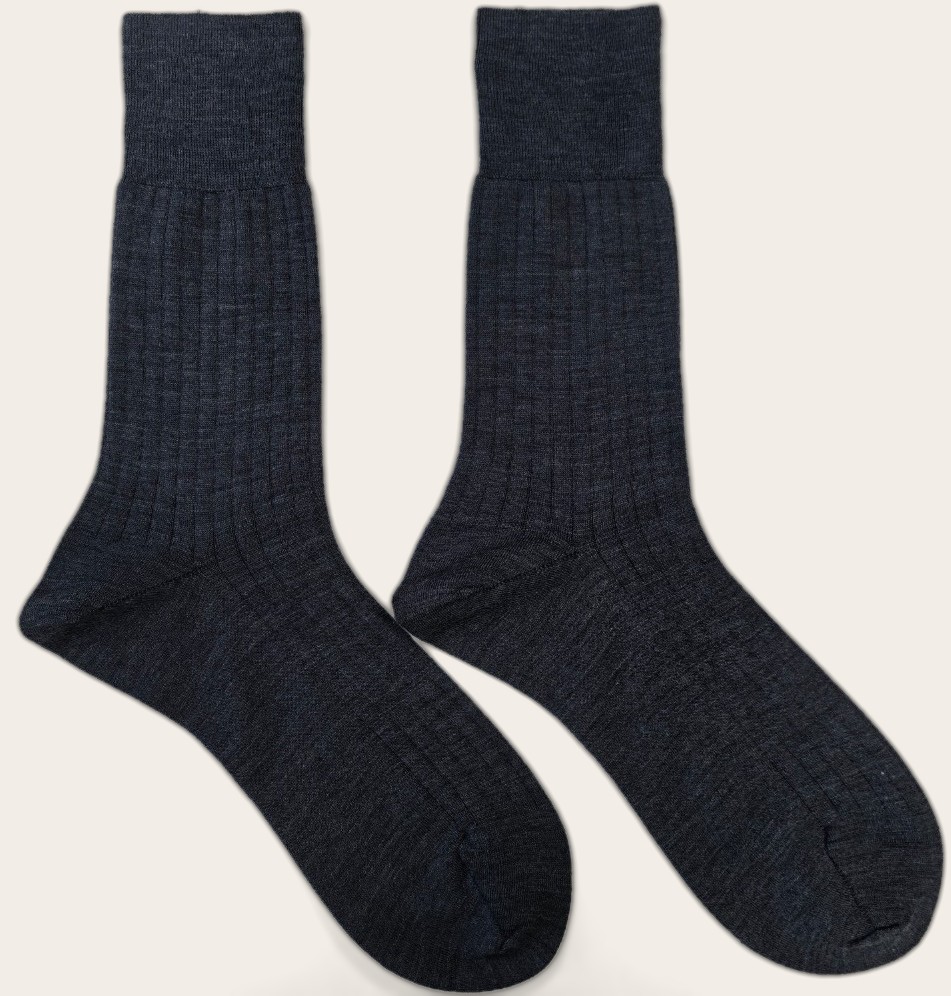
- 240N merino rib — heavier dress sock, fully merino, 240 needle, premium category.
Both constructions are available with custom dye-lots, although stock colors (natural grey, undyed cream, navy, charcoal) ship faster. Lead times are 25-30 days from PO to ex-factory for stock-color RWS socks; 35-40 days for custom dye-lots.
Why Some Brands Are Pushing Past RWS
RWS is the floor, not the ceiling. Brands that need stronger welfare claims — particularly the regenerative and biodynamic wool segment — layer additional certifications or sourcing models. ZQ-certified merino from New Zealand covers both welfare and environmental criteria. The Savory Institute's Land-to-Market program adds regenerative outcome verification. Specific fiber origin programs (Tarndwarncoat Estate in Australia, Nativa in New Zealand) brand the wool itself rather than the chain.
For most buyers, however, RWS is the appropriate baseline. FOCS' recommendation is to require RWS as a minimum on any wool program and add additional certifications only where the marketing story justifies the audit cost. The marginal investment in moving from RWS to ZQ is meaningful only if the brand's customer base cares.
How FOCS Handles RWS Documentation
Every RWS shipment from FOCS ships with the mill's RWS scope summary, the yarn TC, the dye-house TC, the finished good TC, a chemical-input declaration, and a fiber origin summary (farm country and flock size, anonymized where the farm prefers). We deliver the documentation pack the day before the goods leave the loading dock, and we provide an interim draft TC for buyer pre-approval if the trade team needs it for customs or retailer listing.
For first-time buyers, we run a 200 to 500-pair sample program with full documentation so the brand can verify the RWS chain in their own name before committing to a season program. Sampling lead time is 7-10 days including yarn swatches.
Frequently Asked Questions
Is RWS certification the same as cruelty-free wool?
Close but not identical. RWS is the most widely adopted animal-welfare standard for wool and explicitly bans mulesing, tail docking, and live export. However, the standard does not require farms to be pasture-raised under all conditions, does not prohibit shearing during pregnancy, and does not require a wool-only diet. For stricter claims (e.g., biodynamic or regenerative wool), other certifications apply.
What does mulesing-free actually mean and how is it verified?
Mulesing is the surgical removal of skin around a merino lamb's tail to prevent flystrike, common in Australian wool until recent reforms. RWS bans the practice completely. Verification combines physical farm inspection, photographic evidence during shearing, and a shearing-floor audit by the certification body. FOCS source mills all accept a maximum 1-year mulesing audit cycle.
Which countries produce RWS-certified wool?
Australia is the largest source of RWS-certified merino, followed by New Zealand (crossbred wool), South Africa, Argentina, and the United States. China and Turkey are significant for blended wool programs but typically source raw wool from certified farms in the countries above.
Does RWS apply to sock knitting and dyeing?
Yes, at the processor level. FOCS holds an RWS scope covering knitting, dyeing, sewing and packaging. Each step tracks wool fiber from intake to finished sock, and every shipment ships with an RWS Transaction Certificate so the buyer can claim RWS status on the finished retail product.
Can recycled wool be combined with RWS wool?
Yes, under specific rules. Recycled wool content can be claimed in addition to RWS, provided the recycling is also certified under GRS or RCS. The finished sock would carry dual certification with separate TCs and a unified labeling guideline. FOCS runs these blended programs for heavier boot socks where recycled wool performs well.
Is RWS accepted by major outdoor and heritage brands?
Yes. RWS is the underlying standard cited by Patagonia, Arc'teryx, Outdoor Voices, and most European outdoor heritage brands for wool products. It is also the basis for the Higg Brand & Retailer Module's animal welfare section. RWS is owned by Textile Exchange, the same organisation behind GRS and OCS.
What is the typical MOQ for RWS wool socks?
Slightly higher than conventional wool programs because of the documentation load. For stock RWS merino yarn in standard colors, FOCS can ship from 500 pairs per design. Custom dye-lots or non-standard yarn counts push MOQ to 1,000–2,000 pairs per design. Sampling lead time is typically 7–10 days with yarn swatches first.
Continue Reading
- FOCS RWS Wool Socks product page
- RWS Wool Clothing for matching sweater ranges
- 240N Merino Rib Dress Socks (premium dress sock recipe)
- GOTS Certification Process Explained
- GRS Recycled Sock Manufacturing: From Waste to Wear in 5 Steps